WHEN THE VISION YOU STARTED WITH FEELS A LONG WAY FROM THE SALON YOU ARE RUNNING
The daily problems can take up so much attention that you lose sight of what you wanted the business to be. How you look at those problems can affect which possibilities you notice and what you try next.
Let’s look at that relationship, without turning a difficult day into a judgement about whether you are a good salon owner.
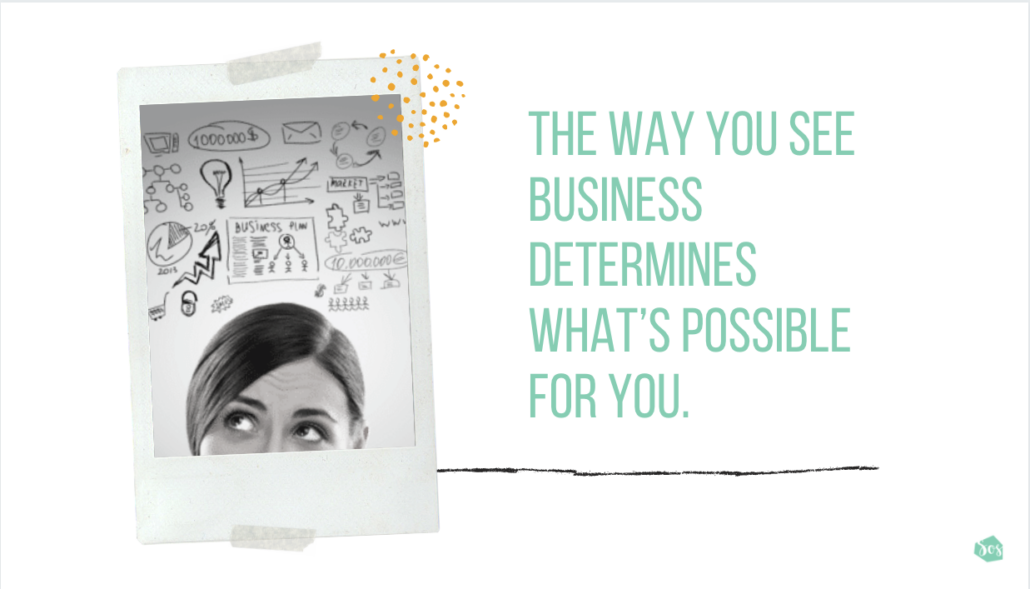
The way you see the business can affect what you notice and try. It does not determine every result, and finding something difficult does not make you less capable as an owner.
Imagine you have run a team meeting about consultations, but still hear the same unclear explanation being given to customers. It would be understandable to wonder whether another meeting is worth the time. The meeting may have helped everyone hear the expectation. What it may not have given them is a chance to practise the wording and check what the customer understood.

“Meetings are a waste of time” and “this explanation needs practice” point you towards different decisions. Looking again does not mean dismissing your frustration. It means finding out what the first attempt helped with and what remains unresolved.
Let’s look at a leadership activity like goal setting.
If goal setting has felt like filling out a page and forgetting it, it makes sense to question its value. Look at what happened after the goal was written: did it guide a decision, become scheduled work or get reviewed when things changed?
Is goal setting in your business life something you only do once a year?
Do you revisit them quarterly?
Are you checking in every week?
What about goal setting? Are you creating realistic goals that you can achieve or do you set huge goals and see who you show up as in the pursuit of them?
Does rewarding achieving goals look like A or B
A, Rewarding yourself ONLY when you achieve your goals or
B, Celebrate the attempts to cast your vision and give things a try.
Do you beat yourself and your team up if goals were not met?
The goal gives you a direction. What you do with it, what you learn and the circumstances you are working in all matter to what happens next.
Check out this blog I wrote on successful goal setting
What do you think will continue to happen if you see parts of your business as:
Frustrating
Overwhelming
Too tough
Annoying
Bad
Stressful
Too Competitive
Difficult
Hard
Time Consuming
Complicated
A waste of time
Too scary
Which of these feelings do you recognise, and what situation tends to bring it up?
When the same problems fill your attention, what becomes difficult to notice or make time for?
A problem can tell you where attention is needed. It may also reveal a real limit on time, money or what you can do yourself. Include that in the decision.
Let me ask you …is the success you desire plus the freedom and life purpose you wanted when you started out still seem possible?
So what can you do instead that will make your salon business seem fun, exciting, a pleasure and fire you up again?
#1 MAKE ROOM FOR CURIOSITY AGAIN
There may have been things you enjoyed imagining when you opened the salon: the work you wanted to do, the atmosphere or the people you wanted to work with. What still interests you about that? You do not have to enjoy every challenge to make room for an idea you want to explore.
So I invite you to bring your creative spirit to how you approach a challenge. What would be interesting to understand or try, instead of seeing only another thing to get through?
This leads to the next common problem we need to change…
#2 LABELLING MISTAKES AS FAILURES
Missing a payment deadline or running out of the team’s favorite lightener.
Forgetting a scheduled meeting, having a disastrous performance review…
Upsetting a client over her appointment, mischarging someone, or getting yelled at by someone who doesn’t respect you and your salons’ values.
These are all mistakes large and small but part of the daily for a salon owner.
How you understand a mistake can affect what you do next. Some mistakes also have practical consequences that need attention, whatever you call them.
A mistake can also be a signpost. After dealing with its effect, ask what would help you avoid repeating it.
What system, assistance, automation or strategies could you look at to alleviate the pressure and overwhelm that once comes up just seems to get worse!!
GIVE YOURSELF ROOM TO LOOK AT THE PROBLEM DIFFERENTLY
#3 WHEN AN EVENT CHANGES WHAT YOU HAD PLANNED
Have you ever been fired….. the worst day ever!!
The breakup that literally broke your heart!! Missing out on the house of your dreams. The friend that let you down big time!! These can all be very hard to move on from.
In business we have these uncertain and unpredictable outcome events show up all the time!
Your star stylist resigns… and takes a bunch of your team with them. Your landlord does not renew your lease. A disgruntled customer wrote false, horrible reviews on social media!! Your stylist breaks her ankle and is off work for 2 months. A team member leaves and takes a personal grievance. Catastrophes!!
You may have faced a different kind of challenge. It does not have to look like these examples to deserve your attention.
If you have had these kinds of things happen can you now look back and realise that these events were the turning point that led you on a journey to where you are now.
There may be something you learned that changed how you now work. There may also be something that is still difficult. You do not have to give an event a happy ending before looking at what support or change would help.
Maybe it led you to adopt a better strategy or process to limit the possibility of it happening again. Maybe the next thing that came along was better than what you had ‘lost’
#4 THINKING OBSTACLES ARE BRICK WALLS.
We come up against obstacles for ourselves and within our business every day.
A product company that won’t supply you. Your bank won’t extend your OD.
A team member questioning a change you want to make.
A customer declining a treatment you thought would help.
Repeated refusals can be exhausting. Start with what is actually unavailable and what options are still open to you. A supplier saying no and a customer asking for more information are different situations; a changed perspective may help you see another option, but it does not make every limit disappear.
How you interpret what happened can influence your next decision. Start with what the other person actually said or did, rather than assuming the reason.
What can you learn here, and what help or information would make the next decision clearer? Sometimes the answer is a different approach. Sometimes an option really is unavailable and you need to consider another one.
Next time you find yourself facing an obstacle, challenge yourself to find a solution. Give yourself enough time to understand what happened, then consider what could change. If you find yourself going round the same complaint, a specific question can help you move towards the next step.

#5 FORGETTING TO UNDERSTAND HOW YOUR CUSTOMER SEES IT
What do you think will happen if you are constantly stuck in the perception that business is difficult, too competitive, and frustrating.
Does this allow you to be a great problem solver for your customers?
Being bogged down in the weeds of a frustrating, complicated business that drains you of your energy means your focus is not on them.
Use the same curiosity you bring to a consultation. If a customer says a routine is too much work, ask what part they mean. They may be talking about daily styling, the number of products or the time between salon visits. Those answers could lead to different recommendations.
#6 IGNORING LEADERSHIP PRINCIPLES
I’m curious…has anyone pointed out to you that great leaders are solution focused and learn how to tackle problems in their business using the
Reframe, Refocus and Realign Framework?
In the A.S.C.E.N.D Salon Method, we go through each pillar
Attraction
Structure
Connection
Empower
Nurture
Delegate
with this focus.
Business brings challenges, and you do not need to have every answer yourself. Understanding the problem and finding the right support are part of moving forward.
Is there a decision you keep putting off because you cannot yet see a workable next step? What information, support or alternative would help you consider it more clearly?
Is there a conversation you are avoiding? Work out what needs to be explained or understood before deciding what to say. If it is about price, return to the service, its costs and what the business needs to support.
We use the 6 key principles to run over every problem and solution so it does not become a brick wall on your pathway to your salon vision.
They are really good at helping you understand customer and team objections. How many times have you faced them!!
You can explore the related planning and team-meeting articles when you want to work on one of these areas.
Looking inward does not mean making yourself the problem. It means noticing the part of the decision or conversation you can approach differently.
Ask yourself: what am I assuming here, what do I know, and what could I look at differently?